
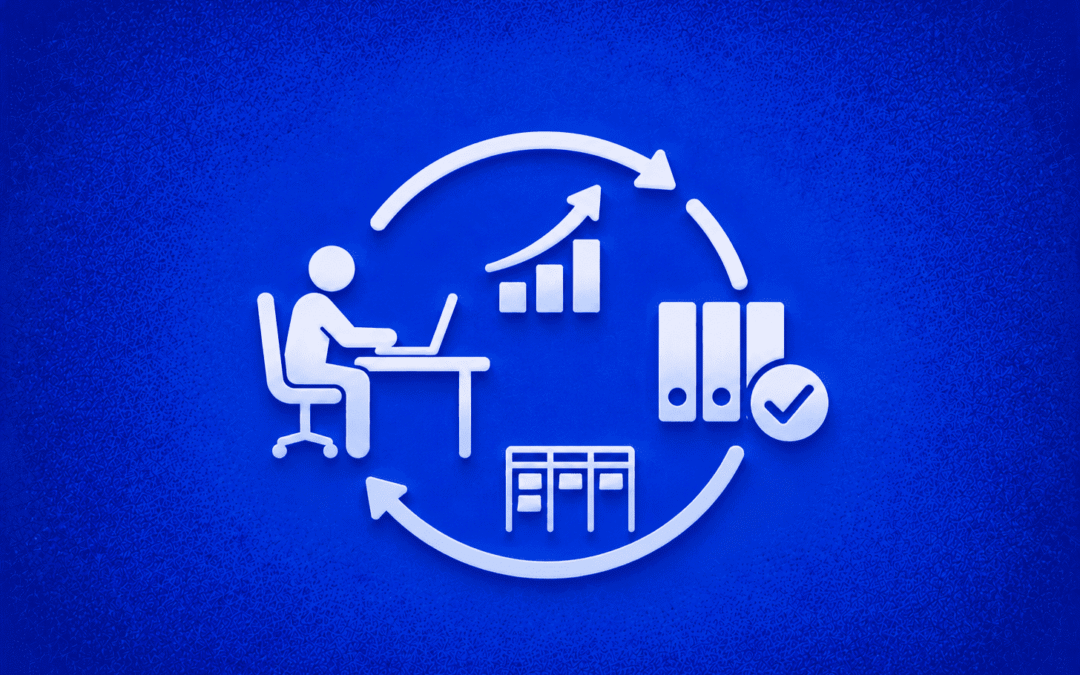
In many organizations, continuous improvement initiatives remain associated with the image of the industrial workshop. Lean tools and optimization projects are perceived as practices reserved for production. Administrative services, by contrast, seem to evolve in a separate universe where processes appear too varied to be standardized.
Yet support functions concentrate a considerable share of an organization’s costs and lead times. Purchasing, human resources, accounting, legal, quality: these activities often condition the final customer experience. Inefficiencies thrive there all the more easily because they remain invisible.
This is precisely what Lean Office addresses. By transposing Lean principles to administrative processes, this approach seeks to make the wastes of the tertiary world visible.
An approach inherited from industry
Lean Office extends the Lean thinking born in industry. It rests on the same fundamentals: identifying value from the customer’s standpoint, mapping flows, hunting wastes, standardizing and improving continuously.
What changes are the objects of work. In a workshop, the flow is physical: a part circulates, transforms, waits, moves on. In an office, the flow is informational: a file, an email, an approval circulate between actors and tools.
This dematerialization makes diagnosis more delicate. Waiting times do not appear as a stock of work in progress. Rework leaves no rejected parts. Wastes exist nonetheless, and often in greater quantity.
Lean Office therefore consists in giving substance to these invisible flows so that they can be improved.
Typical wastes in office environments
The seven classic wastes transpose quite naturally to administrative services. Their expression changes, but their logic remains identical. Among the most frequent forms observed in office environments:
- information scattered across several tools and files
- duplicate data entry between poorly interfaced systems
- multiple approvals with no real added value
- waiting between departments that slow down files
- rework caused by incomplete or erroneous data
These wastes accumulate without any actor measuring their scale. Each operation seems short, each request seems legitimate. It is the accumulation that weighs, not the isolated step.
Making visible what is not visible constitutes the first step of Lean Office.
Why potential gains are often larger
In a mature workshop, optimization projects come up against narrow improvement margins. Flows are already known, measured, tracked. Gains are won percentage by percentage.
In administrative services, the situation is reversed. Processes have often never been mapped. Lead times are not measured and habits are passed on orally.
This absence of history explains the scale of potential gains. A simple mapping reveals redundant steps, avoidable back-and-forths, approvals that have become automatic.
Lean Office thus finds its most fertile ground in the zones that have never been questioned.
Mapping before transforming
Process mapping is the central tool of Lean Office. It visually represents the path of a file through the different steps and the different actors.
This exercise seems simple. It is often revealing. Participants discover steps they ignored, loops for which no one is responsible, controls whose origin has been forgotten.
Mapping allows distinguishing what brings value to the customer, what is necessary without direct added value, and what can be removed without consequence.
Without a shared representation of the process, each actor defends their own perception. With a common mapping, the debate shifts to facts.
Standardizing without rigidifying
The idea of standardization meets particular resistance in services. Employees fear a loss of autonomy, a tightening of control, a dehumanization of work.
Lean Office approaches standardization differently. It is not about freezing practices but about defining a shared reference that then serves as a basis for improvement. Without a standard, each improvement is ephemeral. With a standard, progress takes root over time.
A good standard describes what must be done, not the unique way of doing it. It leaves room for adaptation to particular situations.
Standardizing also means simplifying.
The role of management in deploying Lean Office
The deployment of Lean Office rests largely on the posture of management. Without visible managerial commitment, initiatives remain occasional and their effects fade quickly.
Management largely determines how Lean Office is experienced in the organization. When it is used as a tool of control or of imposed productivity, teams protect themselves. Diagnoses become cautious, improvement leads self-censor and wastes remain invisible.
Conversely, when it is carried as a lever of collective learning, teams participate actively. They identify the irritants themselves, suggest simplifications and take ownership of the standards. The initiative becomes a space for professional expression rather than a top-down injunction.
Management also has a structuring role in prioritization. Not all processes can be addressed simultaneously. Choosing the projects, allocating the necessary time, protecting teams from parasitic solicitations during a project: these arbitrations belong to steering.
Managerial posture conditions the depth of Lean Office.
The conditions for a successful deployment
Lean Office produces its effects only under certain conditions. The first concerns customer orientation. Without a clear understanding of what constitutes value for the recipient of the process, optimizations target the wrong topics.
The second condition concerns data availability. Measuring lead times, volumes and error rates requires a minimum of instrumentation. This data often exists but remains scattered.
The third condition concerns the time granted to the initiative. Mapping, analyzing, experimenting, adjusting: these steps require an initial investment that teams cannot absorb without a clear frame.
These three conditions being met, Lean Office can transform the performance of support functions.
From the invisible to sustainable performance
Lean Office is not limited to a method for optimizing offices. It progressively becomes a way of operating that makes visible the value produced by administrative services.
The benefits are not limited to shortened lead times or avoided errors. They also touch the quality of the work experience. Clear processes and shared standards constitute a more motivating environment than the accumulation of urgencies and workarounds.
Over the course of projects, the organization develops an internal capacity to analyze its own processes. This capacity becomes a strategic asset as valuable as short-term operational gains.
Lean Office thus transforms support functions, long considered as cost centers, into contributors to overall performance.
Key takeaways
- Lean Office transposes Lean principles to administrative services
- The flows are informational, not physical
- Tertiary wastes are invisible but massive
- Potential gains are often larger than in industry
- Mapping reveals redundant or useless steps
- Standardization creates the basis for lasting improvements
- Management conditions the depth of the initiative
- Lean Office strengthens the sustainable performance of support functions